MS Arthroscopic · FASM · FIJR
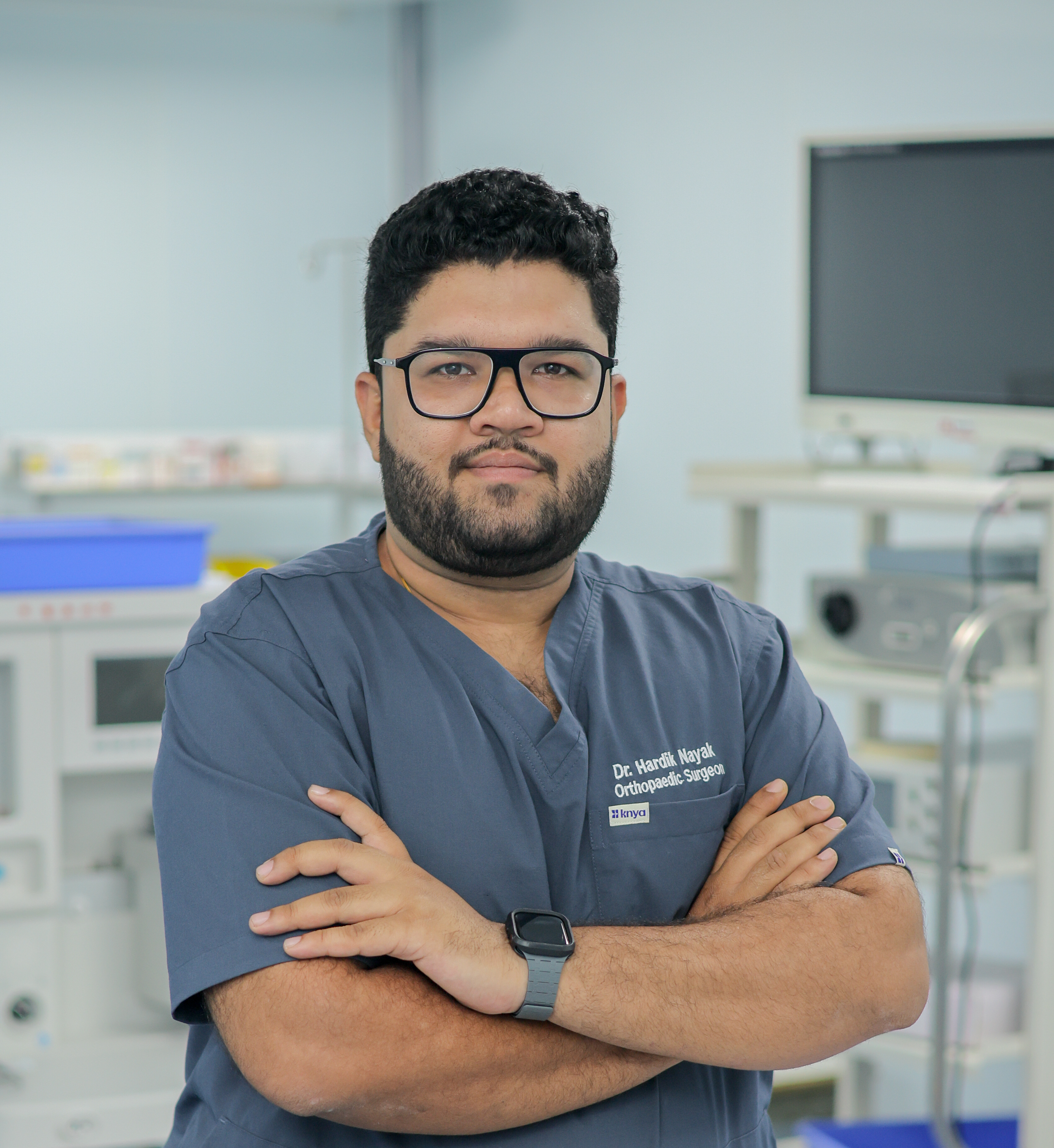
Dr. Hardik Nayak
Mehsana's Leading Arthroscopic Surgeon & Sports Injury Specialist
Dr. Hardik Nayak is the arthroscopic and sports injury surgeon at Axcura Ortho, Mehsana, with a practice built entirely around minimally invasive joint surgery. Whether it is a torn ACL from a cricket match, a rotator cuff injury that has been limiting your shoulder for months, or a frozen shoulder that has stopped you sleeping through the night — Dr. Hardik has seen it, operated on it and gotten patients back to full activity. His approach: small incisions, precise technique, faster recovery. No unnecessary open surgery when an arthroscopic solution exists.
Sports Injury Specialist
About Dr. Hardik Nayak — Arthroscopic Surgeon & Sports Medicine Specialist, Axcura Ortho Mehsana
Dr. Hardik Nayak's Training, Qualifications & Arthroscopic Expertise
Dr. Hardik Nayak trained in arthroscopic surgery with a focused specialisation in minimally invasive joint procedures — a discipline that requires dedicated fellowship training beyond standard orthopaedic qualification. At Axcura Ortho in Mehsana, he brings advanced arthroscopic technique to patients who would otherwise have to travel to Ahmedabad or beyond for this level of care. His practice covers the full spectrum of arthroscopic joint surgery, from knee and shoulder procedures to complex ligament reconstructions and cartilage repair.
Sports Injury Diagnosis & Treatment — Knee, Shoulder & Ligament Injuries, Mehsana
From school-level athletes to weekend cricketers to professional sportspeople, Dr. Hardik manages the full range of sports-related joint injuries. Knee injuries — ACL tears, meniscus damage, patella dislocations — are the most common. Shoulder injuries from overhead sports, contact sports and weightlifting are a close second. What sets Dr. Hardik's approach apart is that the goal is never just to fix the injury — it is to get you back to the exact activity that caused it, with a plan that reduces the risk of it happening again.
Looking for a specialized opinion?
Consult with Mehsana's trusted arthroscopic specialist today.
Check Appointment Slots →Arthroscopic Procedures — Knee Arthroscopy, ACL Surgery, Rotator Cuff & Shoulder Arthroscopy, Mehsana
Knee Arthroscopy & ACL Reconstruction in Mehsana
Knee arthroscopy is one of the most common arthroscopic procedures performed globally — and for good reason. Through two or three small incisions no larger than a keyhole, Dr. Hardik can diagnose and treat a wide range of knee conditions including ACL tears, meniscus damage, cartilage wear and loose body removal. ACL reconstruction is performed using a graft technique that restores full knee stability, allowing patients — including competitive athletes — to return to sport. Recovery after knee arthroscopy is significantly faster than after traditional open knee surgery, with most patients bearing weight on the same day.
What Conditions Are Treated with Knee Arthroscopy?
🧬 Knee arthroscopy can diagnose and treat ACL and PCL tears, meniscus tears (repair or partial removal), cartilage damage, loose bone or cartilage fragments in the joint, patella (kneecap) instability, Baker's cyst drainage and general joint inflammation. Each of these is a separate condition with its own symptoms — Dr. Hardik will identify exactly what is happening in your knee before recommending the appropriate procedure.
Shoulder Arthroscopy & Rotator Cuff Surgery in Mehsana
The rotator cuff is a group of four muscles and tendons that hold the shoulder joint together and power its movement. When the rotator cuff is torn — whether from a sudden injury or years of repetitive strain — the result is pain, weakness and a shoulder that just does not work properly anymore. Dr. Hardik performs rotator cuff surgery arthroscopically, repairing the torn tendon through small incisions rather than opening the entire shoulder. Patients experience less post-operative pain, a lower infection risk and a faster return to daily activity compared to open rotator cuff surgery.
Do I Need Surgery for a Rotator Cuff Tear?
💪Not every rotator cuff tear requires surgery. Small partial tears often respond well to physiotherapy, anti-inflammatory treatment and guided strengthening. However, full-thickness tears — especially in active patients or those whose symptoms have not improved after several months of conservative treatment — are much better treated surgically. The longer a full tear is left without repair, the more the torn tendon retracts and the muscle weakens, making eventual surgery more difficult. Dr. Hardik will review your MRI and advise honestly on whether surgery is genuinely necessary in your case.
Meniscus Repair, Cartilage Restoration & Ligament Surgery in Mehsana
🩹 Not every knee problem is a simple ACL tear. Dr. Hardik routinely performs arthroscopic meniscus repair and partial meniscectomy for meniscal tears, microfracture and cartilage restoration procedures for cartilage damage, and ligament reconstruction for multi-ligament knee injuries. Each of these is done arthroscopically where possible — through small incisions, with shorter hospital stays and faster return to normal life than traditional open procedures.
Knee Preservation — Protecting Your Natural Knee, Mehsana
Not every knee problem needs to end in replacement. Knee preservation is the philosophy of treating knee damage in a way that delays or avoids the need for a joint replacement altogether — keeping your natural knee working for as long as possible. Dr. Hardik Nayak applies this approach first, using arthroscopic and biological techniques to address cartilage damage, ligament injuries and early arthritis before they progress to a point where replacement becomes necessary.
Cartilage Restoration & Joint Preservation Techniques, Mehsana
Cartilage does not heal on its own — once it is damaged, the body cannot regenerate it naturally. Left untreated, even a localised cartilage lesion will progress to widespread arthritis over time. Dr. Hardik uses arthroscopic cartilage restoration techniques — including microfracture stimulation and cartilage repair procedures — to address focal cartilage damage before it spreads. When combined with proper rehabilitation, these procedures can significantly extend the lifespan of the natural knee and restore pain-free function in younger and active patients who are not yet candidates for replacement.
Ligament Reconstruction & Knee Stability, Mehsana
An unstable knee — caused by a torn ACL, PCL or multiple ligament injury — does far more damage than the initial ligament tear itself. Every time the knee gives way, it grinds cartilage and stresses the meniscus, accelerating the path toward arthritis. Reconstructing the ligament and restoring knee stability is one of the most important knee preservation interventions available. Dr. Hardik performs ACL and multi-ligament reconstruction arthroscopically, restoring the mechanical stability that protects the rest of the joint from progressive damage.
Meniscus Preservation — Why Saving the Meniscus Matters
The meniscus acts as the shock absorber of the knee — without it, the joint degenerates rapidly. Where possible, Dr. Hardik prioritises meniscus repair over removal. A repaired meniscus that heals successfully protects the knee cartilage for decades. Not all tears are repairable — location, pattern and blood supply all determine this — but Dr. Hardik’s approach is always to attempt repair first and remove only what is absolutely necessary. Preserving even part of the meniscus makes a measurable long-term difference to knee health.
Who Benefits Most from Knee Preservation Treatment?
Knee preservation is most impactful in younger patients (typically under 55), active individuals who want to return to sport, and patients with focal or early-stage damage that has not yet progressed to full arthritis. If you have been told your knee has cartilage damage, a meniscal tear or ligament injury — and you are not ready to consider replacement — a knee preservation consultation with Dr. Hardik at Axcura Ortho, Mehsana, is the right next step.
Shoulder Treatments — Mehsana
Specialised care for complex shoulder conditions
Reverse Shoulder Replacement
SurgicalWhen the rotator cuff is too severely damaged for a standard replacement, this procedure reverses the ball-and-socket geometry — placing the ball on the shoulder blade side and socket on the arm bone side. The deltoid muscle compensates, restoring a stable, pain-free shoulder. Dr. Hardik Nayak performs this advanced procedure at Axcura Ortho.
Frozen Shoulder Treatment
Surgical & Non-surgicalAdhesive capsulitis causes the joint capsule to thicken and tighten over months or years. Early stages respond well to physiotherapy, injections & anti-inflammatories. Where conservative care fails, arthroscopic capsular release restores movement often within just a few weeks of surgery.
Frequently Asked
Can frozen shoulder be treated without surgery?
Yes — many cases respond to non-surgical care, particularly when caught early. Physiotherapy, corticosteroid injections, and anti-inflammatory medication can reduce pain and gradually restore movement during the freezing and early frozen stages. However, if the shoulder has been severely restricted for more than six months with no meaningful improvement, arthroscopic capsular release is significantly more effective than continuing conservative treatment. Dr. Hardik will be direct about which stage you are at and whether surgery is likely to make a real difference.
Why Choose Us
Why Choose Dr. Hardik Nayak — Minimally Invasive Arthroscopic Care in Mehsana
There are general orthopaedic surgeons, and there are arthroscopic specialists. Dr. Hardik Nayak is the latter — a surgeon whose entire practice is built around minimally invasive joint procedures, which means every technique, every piece of equipment and every recovery protocol at Axcura Ortho is optimised for arthroscopic outcomes.
Dr. Hardik Nayak
Arthroscopic Surgeon · Axcura Ortho
-
Dedicated arthroscopic specialistnot a general surgeon doing occasional arthroscopy
-
Full arthroscopic capabilityknee, shoulder, ACL, rotator cuff, meniscus, cartilage
-
Advanced proceduresreverse shoulder replacement and frozen shoulder arthroscopic release
-
Faster recovery, smaller incisions, less post-operative painevery time
-
Sports injury expertisefor patients aged 16 to 60
-
Serving Mehsana, Visnagar, Unjha, Patan, Sidhpur, Vadnagarand all of North Gujarat
Serving Patients Across Mehsana, Visnagar, Unjha, Patan, Sidhpur & North Gujarat
Axcura Ortho in Mehsana is the arthroscopic surgery centre of choice for patients across North Gujarat. Whether you are from Mehsana city or travelling from Visnagar, Unjha, Patan, Sidhpur or Vadnagar, specialist minimally invasive joint care is now available without the journey to Ahmedabad.
Patient FAQs
Frequently Asked Questions — Arthroscopic Surgery & Sports Injury, Mehsana
What is arthroscopic surgery and how is it different from open joint surgery?
Arthroscopic surgery is a minimally invasive surgical technique where the surgeon operates inside a joint using a thin camera — called an arthroscope — and small specialised instruments, all inserted through incisions that are typically less than a centimetre long. In traditional open surgery, the surgeon makes a large incision to see and access the joint directly, which means cutting through more tissue, longer healing time and greater post-operative pain. With arthroscopy, the camera sends a magnified image to a screen in the operating theatre, giving the surgeon an exceptionally clear view of the joint without the trauma of opening it up. The practical result for patients: smaller scars, significantly less pain in the days after surgery, a much lower risk of infection and a faster return to normal activity — often weeks faster than open surgery for the same condition.
I've been told I have an ACL tear. Do I definitely need surgery?
Not every ACL tear requires surgery — it depends on your age, activity level and how stable your knee is in daily life. For younger patients, athletes or anyone who wants to return to sport or physically demanding activity, ACL reconstruction surgery is almost always recommended, because a torn ACL does not heal on its own and an unstable knee will keep giving way, risking further damage to the cartilage and meniscus over time. For older, less active patients, a comprehensive physiotherapy programme can sometimes manage the instability well enough for daily life. Dr. Hardik will assess your knee thoroughly — including an MRI review — and give you an honest recommendation based on your lifestyle and goals, not a one-size-fits-all answer.
What is the difference between rotator cuff surgery and reverse shoulder replacement?
These are two different procedures for two different problems, though both involve the rotator cuff. Rotator cuff surgery — specifically arthroscopic rotator cuff repair — is performed when the tendons of the rotator cuff are torn but the shoulder joint itself is still intact. The surgeon reattaches the torn tendon to the bone using small anchors, all arthroscopically through tiny incisions. The natural shoulder joint is preserved. Reverse shoulder replacement is a more extensive procedure for situations where the rotator cuff is so severely and irreparably damaged that repair is no longer possible, and the damage has typically caused significant arthritis as well. Dr. Hardik will determine which procedure is appropriate based on the extent of your damage, your age and your functional goals.
How long does frozen shoulder last, and when does it need treatment?
Frozen shoulder typically progresses through three stages: the freezing stage, where pain gradually increases and movement begins to reduce; the frozen stage, where movement is severely restricted but pain may ease slightly; and the thawing stage, where movement slowly returns. Without treatment, the full cycle can take anywhere from one to three years. With appropriate treatment, recovery is significantly faster. In the early stages, guided physiotherapy, anti-inflammatory medication and corticosteroid injections can manage symptoms effectively. If the shoulder has been frozen for several months and is not improving, arthroscopic capsular release is a straightforward procedure that cuts through the tight scar tissue inside the shoulder joint, restoring movement rapidly.
Why should patients from Mehsana and North Gujarat choose Dr. Hardik Nayak for arthroscopic surgery?
The honest answer is specialisation. Arthroscopy is a technically demanding discipline — the outcomes depend heavily on how much of a surgeon's practice is focused on arthroscopic work, because volume and experience directly translate to precision inside the joint. Dr. Hardik Nayak's practice at Axcura Ortho is built entirely around arthroscopic and sports injury surgery. Every procedure he performs — from a routine knee arthroscopy to a complex reverse shoulder replacement or frozen shoulder release — uses minimally invasive technique. For patients in Mehsana, Visnagar, Unjha, Patan, Sidhpur and across North Gujarat, this means you do not need to travel to Ahmedabad to access this level of arthroscopic expertise.
Dr. Hardik Nayak
Arthroscopic Surgeon · Axcura Ortho, Mehsana