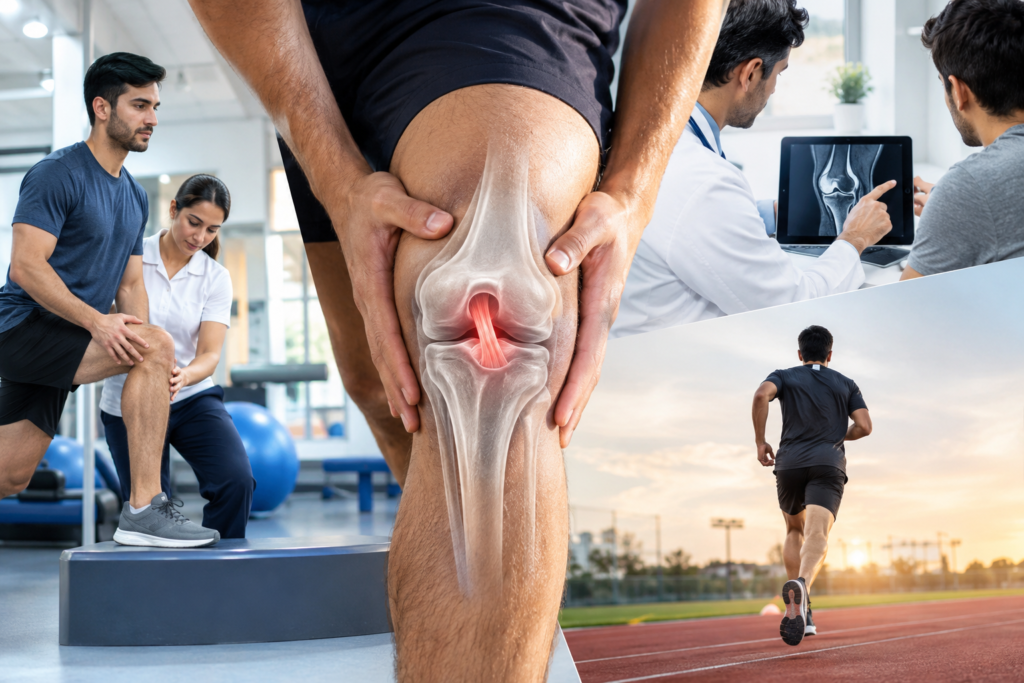
"When can I play again?" is almost always the first question after an ACL tear, and it is usually asked before the swelling has even gone down. The honest, evidence-based answer disappoints most people the first time they hear it: not six months, and not on a fixed calendar date at all. This piece covers what the actual research says about ACL recovery time, why the number is 9 to 12 months for most athletes returning to pivoting sport, and, more importantly, how that date is actually decided.
The Short Answer: 9 to 12 Months, Not 6
For most athletes returning to cutting, pivoting or contact sport, full, medically supported return to sport after ACL reconstruction falls between 9 and 12 months. A smaller number of patients, in low-demand, straight-line activities, may be cleared closer to 6 to 7 months. The "6 months" figure that circulates widely in casual sports conversation reflects an older, now largely outdated standard. Current research links earlier return to a substantially higher risk of re-tearing the graft, covered in detail below.
At Axcura Ortho, Dr. Hardik Nayak's ACL reconstruction surgery protocol follows this same evidence-based window, with a criterion-based rather than calendar-based return-to-sport decision for every patient.
Why "6 Months" Keeps Showing Up, and Why It's Misleading
Six months is roughly when many athletes start to feel normal: swelling has resolved, strength is returning, and straight-line running feels confident. It is also, unfortunately, close to when many graft failures used to occur, back when return-to-sport decisions were made primarily on how much time had passed since surgery. Feeling ready and being ready are not the same thing, and the gap between the two is exactly where most re-injuries happen.
The Science: Why Waiting Longer Measurably Lowers Re-Injury Risk
The strongest evidence on this question comes from the Delaware-Oslo ACL cohort study, published in the British Journal of Sports Medicine, which followed athletes returning to pivoting sport after ACL reconstruction. Its central finding is striking: for every month an athlete delayed their return to sport, up to nine months post-surgery, their rate of reinjury dropped by roughly 51 percent. This is not a small effect driven by a handful of cases. It is one of the most frequently cited pieces of evidence behind the shift away from fixed, calendar-based return timelines and toward the criteria-based model used today.
The biological reason behind this is straightforward. The ACL graft, whether hamstring, patellar tendon or quadriceps tendon, is living tissue undergoing a process called ligamentisation, where the graft is gradually remodelled by the body into functional ligament tissue over many months. Early on, the graft is at its biologically weakest point, even though pain and swelling may have already resolved. Returning to high-load, pivoting activity before this process has matured is the single biggest modifiable risk factor for re-tear.
Recovery Isn't a Calendar, It's a Checklist
Modern return-to-sport decisions are criteria-based: a set of objective tests an athlete must pass, regardless of how many months have elapsed. The most commonly used criteria include:
The Single-Leg Hop Test
A battery of hop tests, single hop for distance, triple hop, crossover hop and timed hop, compares the operated leg's performance to the uninjured leg. Most protocols require at least 90 percent symmetry between legs before clearing an athlete for pivoting sport. This remains the most widely used physical return-to-sport test, though researchers note it works best as one part of a broader assessment rather than a single pass/fail gate.
Strength Symmetry (Quadriceps and Hamstring)
Isokinetic or dynamometer testing compares quadriceps and hamstring strength between the two legs. A strength deficit of more than 10 to 15 percent in the operated leg is generally considered unsafe for return to pivoting sport, since the muscles around the knee provide a large share of its dynamic stability.
Movement Quality Screening
Video or motion-capture analysis of jumping, landing and cutting mechanics identifies compensatory movement patterns, such as favoring the uninjured leg, that raw strength numbers alone can miss. Poor landing mechanics are themselves an independent risk factor for reinjury, separate from strength or hop symmetry.
Psychological Readiness: The Criteria Most People Forget
A knee can pass every physical test and still not be ready. Fear of re-injury, often called kinesiophobia in the sports medicine literature, is one of the most consistent predictors of whether an athlete actually returns to their pre-injury level of sport, independent of their physical test results. Validated questionnaires such as the ACL Return to Sport after Injury (ACL-RSI) scale are increasingly used alongside physical testing for exactly this reason. An athlete who physically could return but is still flinching on landings or avoiding certain movements is not actually ready, and pushing that athlete back onto the field typically ends badly.
Does Graft Type Change Your Return-to-Sport Timeline?
Not significantly, when rehabilitation is properly matched to the graft. Hamstring tendon, bone-patellar tendon-bone (BPTB) and quadriceps tendon grafts each have slightly different early healing properties, BPTB grafts, for example, benefit from faster bone-to-bone fixation at the attachment points, but current evidence shows the overall return-to-sport timeline converges to a similar 9 to 12 month window across graft types once rehabilitation accounts for each graft's specific healing profile. Graft selection has a larger impact on donor-site recovery and long-term durability than on the headline return-to-sport date. Our ACL reconstruction page covers how Dr. Hardik Nayak selects between hamstring, BPTB, quadriceps tendon and synthetic graft options for each patient.
Why Female Athletes Often Need a Slightly Longer Runway
Research consistently shows female athletes face a higher baseline risk of ACL injury and re-injury than male athletes in the same sports, for reasons including hormonal, anatomical and neuromuscular factors. Several return-to-sport protocols now build this into the timeline directly: while male athletes often progress to formal return-to-sport testing around month 6 to 7, many protocols extend this to month 7 to 8 for female athletes, with particular additional emphasis on hip and trunk strength testing, since hip control plays an outsized role in knee stability during cutting and landing for female athletes specifically. This is not a blanket rule for every patient, but a pattern that should factor into an individualised rehabilitation plan rather than a generic one-size timeline.
Sport-Specific Return: Cricket, Football and Kabaddi
Generic return-to-sport guidance is written around international sports medicine research, which is overwhelmingly built on football (soccer), basketball and American football cohorts. For athletes in North Gujarat, the sports that matter most, cricket, football and kabaddi, each place a distinct demand profile on a reconstructed knee, and return timelines should reflect that.
- Cricket involves explosive sprinting, sudden direction changes while fielding, and repeated bowling or batting rotation; fast bowlers in particular load the front knee heavily on delivery stride.
- Football (soccer) demands constant cutting, pivoting and unpredictable contact, placing it firmly in the higher-risk category where the full 9 to 12 month, criteria-based timeline applies without shortcuts.
- Kabaddi combines explosive lateral movement, sudden stops, and direct contact during raids and tackles, a combination that stresses the ACL graft in multiple directions simultaneously.
Dr. Hardik Nayak's sports injury treatment program at Axcura Ortho builds the rehabilitation plan around the specific sport an athlete is returning to, not a generic protocol, which is why patients returning to cricket, football and kabaddi have been able to get back to competitive play at the 8 to 9 month mark with testing-confirmed readiness.
What Happens If You Return Too Early
Returning before the graft has biologically matured and before strength, movement and psychological criteria are met is the leading cause of ACL graft failure. A second tear is not simply "starting over": revision ACL reconstruction is significantly more complex than a first-time procedure, often requiring CT evaluation of the existing tunnels, a different graft strategy, and in some cases a staged surgery involving bone grafting before the ligament itself can even be reconstructed. The month saved by returning early is rarely worth the year or more that a graft failure can cost.
How an Arthroscopic, Criteria-Based Protocol Works at Axcura Ortho
Every ACL reconstruction at Axcura Ortho is performed arthroscopically, through small keyhole incisions, by Dr. Hardik Nayak, an arthroscopic surgeon specialising in knee ligament reconstruction and sports injury. The return-to-sport decision is built around the same evidence this piece has covered: hop test symmetry, strength testing, movement quality and psychological readiness, rather than a fixed date on a calendar. Patients across Mehsana, Visnagar, Unjha, Patan, Sidhpur and Vadnagar are guided through this exact process, from the initial ACL assessment through to a confirmed, tested return to their sport.
Frequently Asked Questions
Common questions about ACL injury recovery and return to sport at Axcura Ortho, Mehsana.
What is the fastest someone can safely return to sport after ACL surgery?
Some low-demand, straight-line athletes are cleared around 6 to 7 months, but for cutting, pivoting or contact sport, evidence strongly supports waiting until at least 9 months and until objective criteria, not just time, have been met.
Is recovery time different for a meniscus repair done at the same time as ACL reconstruction?
Yes. When a meniscus tear is repaired (rather than trimmed) at the same time as ACL reconstruction, weight-bearing and range-of-motion progression is often more cautious in the early weeks to protect the meniscal repair, which can add time to the early phases of rehab, though it does not necessarily change the final return-to-sport window.
Can you reinjure your ACL even after being medically cleared?
Yes, clearance reduces risk substantially but does not eliminate it. Reported re-tear rates after reconstruction are approximately 5 to 15 percent, with younger athletes returning to high-demand pivoting sport at the higher end of that range.
Does wearing a knee brace after clearance reduce reinjury risk?
Evidence on functional bracing after full clearance is mixed, some surgeons recommend a supportive brace for 1 to 2 years in high-demand pivoting sport as an additional precaution, while others rely primarily on strength and movement quality. This is typically an individual decision made with your surgeon.
How is return-to-sport timing different for a revision ACL reconstruction?
Revision reconstruction generally requires a longer and more conservative timeline than a primary reconstruction, since the surgical planning is more complex and the tissue has already failed once. Our ACL reconstruction and revision surgery page covers what revision planning involves in more detail.
The Real Answer to "When Can I Play Again?"
The honest timeline is 9 to 12 months for most athletes returning to pivoting sport, decided by objective testing rather than a date circled on a calendar. If you have recently torn your ACL, or you're mid-recovery and unsure whether you are actually ready, a proper assessment against these exact criteria, hop symmetry, strength, movement quality and psychological readiness, is the only way to know for certain. Dr. Hardik Nayak and the team at Axcura Ortho in Mehsana can walk you through exactly where you stand.