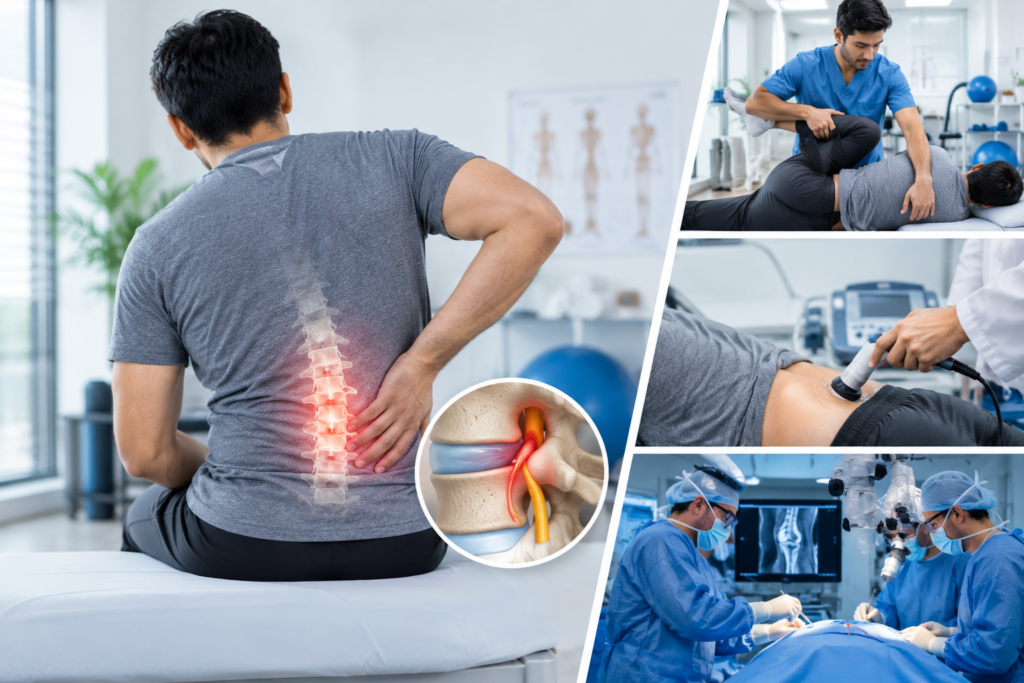
A slip disc does not always mean spine surgery. In fact, most patients with a lumbar disc herniation improve with structured non-surgical treatment over six to twelve weeks, while surgery is needed only in specific situations where nerve compression is severe, worsening, or causing an emergency.
At Slip Disc Treatment in Mehsana, the focus is on accurate diagnosis first, then recommending the least invasive treatment that can safely relieve your symptoms and protect nerve function.
What Is a Slip Disc?
A “slip disc” is a common term for a disc herniation or prolapsed intervertebral disc (PIVD). The soft inner part of the spinal disc pushes through a weakness in its outer layer and may press on a nearby nerve root, causing pain, tingling, numbness, or weakness.
Disc problems most often occur in the lower back, especially at L4-L5 or L5-S1, and in the neck, commonly at C5-C6 or C6-C7. The exact symptoms depend on which disc is affected and which nerve is compressed.
Common Symptoms of a Slip Disc
A slip disc can affect the lower back, neck, or rarely the middle back. Typical warning signs include:
- Lower back pain radiating into the buttock, thigh, or leg, often called sciatica.
- Neck pain spreading to the shoulder, arm, or hand.
- Burning, electric, or shooting pain along the nerve pathway.
- Numbness or tingling in the leg, foot, arm, or fingers.
- Pain that worsens with coughing, sneezing, bending, or prolonged sitting.
- Weakness in the leg, foot, hand, or grip.
Can a Slip Disc Heal Without Surgery?
Yes. Most slip disc cases do not require an operation. Approximately 90 percent of patients with lumbar disc herniation improve with well-planned non-surgical management over six to twelve weeks.
The goal of non-surgical treatment is to reduce inflammation around the nerve, allow the irritated disc to settle, restore movement, and strengthen the muscles that support the spine. Complete bed rest is usually not helpful; controlled activity and guided rehabilitation are more effective.
Non-Surgical Slip Disc Treatment Options
Activity Modification
Short-term changes in lifting, sitting, bending, and work posture can reduce stress on the affected disc. The aim is not to stop moving completely, but to avoid movements that repeatedly irritate the nerve.
Medicines for Pain and Nerve Irritation
Anti-inflammatory medicines, nerve-related pain medicines, and muscle relaxants may be used for a limited period to control acute pain and help you participate in rehabilitation.
Targeted Physiotherapy
A structured physiotherapy programme can reduce nerve irritation, improve spinal mobility, correct contributing posture and muscle weakness, and progressively rebuild core stability. Generic exercises are not the same as a programme designed for your disc level and stage of recovery.
Epidural Steroid Injection
An epidural steroid injection delivers anti-inflammatory medicine close to the irritated nerve root. It can reduce pain and create a window in which physiotherapy and daily activities become easier.
Selective Nerve Root Block
A selective nerve root block targets a specific nerve root with local anaesthetic and steroid. It may help confirm the source of pain while also providing therapeutic relief.
When Does a Slip Disc Actually Need Surgery?
Surgery is not the first choice for a slip disc, but it may be the right choice when non-surgical treatment has not worked or when there are signs of significant nerve compromise. At Slip Disc Treatment in Mehsana, surgery is considered only after a careful review of your symptoms, examination findings, imaging, and response to treatment.
You may need surgical assessment if you have:
- Persistent leg or arm pain that does not improve after an adequate course of conservative treatment.
- Progressive weakness in the leg, foot, hand, or grip.
- Severe pain that continues to limit walking, sleep, work, or daily life despite proper non-surgical care.
- Recurrent or worsening neurological symptoms rather than gradual improvement.
- Cauda equina symptoms, such as loss of bladder or bowel control, numbness in the groin or inner thighs, or rapidly progressing weakness. This is a surgical emergency and needs immediate assessment.
Emergency Warning Signs You Should Never Ignore
Seek urgent medical care immediately if you develop loss of bladder or bowel control, increasing numbness around the groin or saddle area, or rapidly worsening weakness in both legs. These can indicate cauda equina syndrome, a condition where nerve compression requires urgent decompression.
Do not wait for a routine appointment if these symptoms appear. Early assessment can make a major difference to recovery.
Types of Slip Disc Surgery
Endoscopic Discectomy
Endoscopic discectomy is a minimally invasive keyhole procedure. Using a small incision and an endoscope, the surgeon removes the herniated disc material pressing on the nerve while preserving as much surrounding muscle and bone as possible.
Microdiscectomy
Microdiscectomy is a standard surgical treatment for lumbar disc herniation causing sciatica. The surgeon removes the disc fragment compressing the nerve root through a small incision, usually with excellent relief of leg pain in appropriately selected patients.
Cervical Disc Surgery
For neck disc herniation causing significant arm pain, numbness, weakness, or spinal cord compression, procedures such as anterior cervical discectomy and fusion may be recommended to decompress the nerve or spinal cord.
Decompression or Fusion Surgery
If a disc problem occurs with spinal stenosis, instability, spondylolisthesis, or recurrent herniation, a wider decompression or fusion procedure may be needed. Fusion is not required for a straightforward disc herniation.
How Long Is Recovery After Slip Disc Treatment?
Without Surgery
Many patients notice meaningful improvement within the first six weeks. With consistent rehabilitation, most people recover substantially within three to six months, although severe nerve irritation can take longer.
After Endoscopic Discectomy or Microdiscectomy
Many patients walk on the same day or the next day after surgery and may be discharged within 24 to 48 hours. Light work can often resume within a few weeks, while more physical activity is usually progressed over six to twelve weeks under specialist guidance.
How to Prevent a Slip Disc From Coming Back
- Maintain core strength with a supervised rehabilitation programme.
- Use correct lifting technique: bend the knees, keep the load close, and avoid twisting while lifting.
- Avoid long periods of unsupported sitting; take regular movement breaks.
- Maintain a healthy body weight to reduce load on the lumbar discs.
- Do not ignore new numbness, weakness, or bladder/bowel changes.
Why Choose Expert Spine Care in Mehsana?
A complete slip disc care pathway should include conservative management, injections, endoscopic discectomy, microdiscectomy, and complex spine surgery when genuinely required. Care led by Dr. Sumit Prajapati, Orthopaedic and Spine Surgeon in Mehsana, who has more than 10 years of specialist orthopaedic experience, can help patients receive treatment matched to their condition.
When Should You Book a Specialist Consultation?
Book an assessment if your back or neck pain has not improved after four to six weeks, if pain is spreading into an arm or leg, or if you notice numbness, tingling, or weakness. Early diagnosis helps identify whether your symptoms are truly disc-related and whether non-surgical treatment is likely to work.
Related Orthopaedic Care
Spine pain can sometimes overlap with other joint and nerve-related conditions. If your symptoms include shoulder pain, arm weakness, or difficulty with daily movement, learn more about Shoulder Pain and Frozen Shoulder Treatment in Mehsana.
For active patients recovering from a ligament injury, read ACL Injury Recovery Time: When Can You Really Return to Sport? to understand how rehabilitation and return-to-activity decisions are made.
Patients with activity-related joint or ligament problems can also explore Sports Injury Treatment in Mehsana and Joint Pain Treatment in Mehsana.
Frequently Asked Questions
Common questions about slip disc treatment and surgery at Axcura Ortho, Mehsana.
Does every slip disc need surgery?
No. Most slip discs improve without surgery through medicines, activity modification, physiotherapy, and, when needed, targeted injections.
How long should I try non-surgical treatment?
Many patients are given a structured non-surgical programme for around six to twelve weeks, provided there are no emergency red-flag symptoms or progressive neurological weakness.
Is surgery urgent for a slip disc?
Surgery can be urgent if there is bladder or bowel involvement, saddle numbness, or rapidly worsening weakness. Otherwise, it is usually considered only after appropriate conservative treatment has been tried.
Can a slip disc recur after treatment?
A disc problem can recur, especially if lifting technique, posture, core weakness, or high-risk activities are not addressed. Rehabilitation and long-term spine care reduce this risk.
Who should I consult for slip disc treatment in Mehsana?
You can consult Dr. Sumit Prajapati for slip disc treatment in Mehsana.The clinic offers both non-surgical and surgical spine care under one roof.